
NODiVEC Declares the Old Simulation Playbook Obsolete: Minutes to Onboard, Not Weeks, at a Fraction of Enterprise Cost
Updated: Oct 5
NODiVEC LLC Launches Rheona™: A Physics-Grade Simulation Platform for Metal Additive Manufacturing
NODiVEC LLC has unveiled Rheona™, a groundbreaking simulation platform designed for metal additive manufacturing (AM). This affordable desktop application integrates structural, thermal, and sintering physics. It features an on-device AI advisor and can solve models with millions of elements on standard laptops and PCs. NODiVEC redefines simulation delivery, allowing engineers to onboard in minutes rather than weeks, all at a price that fits any shop floor budget.

Columbia, SC, September 21, 2026 — Today, NODiVEC LLC announced the general availability of Rheona™. This physics-grade simulation platform models the entire build chain, including residual stress, distortion, transient thermal history, and viscous sintering shrinkage. It operates quickly enough to fit into real engineering schedules, running on a workstation instead of a compute cluster.
Metal AM parts often warp, crack, and shrink in ways that CAD models cannot predict. An estimated 70% of AM scrap results from thermal stress and distortion. Every failed build costs metal, machine time, and deadlines. Rheona replaces trial-and-error methods with predictive physics, enabling engineers to identify failures on screen rather than on the build plate.
"Running the simulation was never the hard part — knowing what to do about the result is the job," said Dr. Christian Rossmann, CEO of NODiVEC. "We built Rheona so an AM engineer can predict distortion, residual stress, and sintering shrinkage for a full part in hours. They receive plain-language answers on how to fix issues — all on the machine already on their desk, without a single byte leaving the building. We priced it so the whole shop floor can have it, not just the one seat that could justify a cluster."
The Whole Process Chain, Coupled
The Rheona™ Physics Engine links three high-speed physics solvers through a single, workstation-native finite-element core. These modules actively capture the physical phenomena necessary for the CoEngineer™ AI to provide actionable, physics-based mitigation strategies:
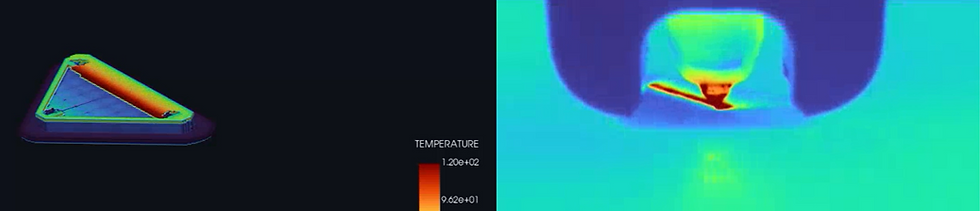
Transient Thermal: This model captures heat input, build-plate conduction, and convective/radiative losses layer by layer. By resolving complex temperature fields that drive thermal accumulation, Rheona enables the AI to prescribe precise inter-layer cooling adjustments to prevent overheating.
Residual Stress & Distortion: An advanced inherent-strain structural solver tracks locked-in stress and warpage that dictate build survivability. It maps recoater interference, support-structure failure, and post-cutoff springback. This empowers the platform to recommend optimal part orientations and precise toolpath rotations before powder is ever laid.
Viscous Sintering: Designed for sinter-based processes, this velocity-based, large-strain solver tracks the significant 15–20% shrinkage, gravity slump, and setter friction that occur throughout the furnace cycle. By simulating live relative-density evolution, the system automatically generates compensated "green" geometries to ensure final dimensional accuracy.
Rheona closes the loop with automatic counter-deformation. It compares the simulated result to nominal CAD and derives the pre-deformed, counter-warped geometry. This geometry springs back — or sinters down — to the intended shape. Instead of iterating counter-deformation by hand across builds, teams receive the compensated geometry that prints and sinters accurately the first time, for both distortion-driven (LPBF/DED) and shrinkage-driven (binder-jet, bound-metal) processes. Rheona effectively covers how metal parts are made, mapping the right physics to each process family: Laser Powder Bed Fusion, Directed Energy Deposition, Metal Binder Jetting, Metal Injection Molding, and Cold Metal Fusion.
Built for Production Speed — On the Hardware You Already Own

The heavy math is compiled to native, multi-threaded code and parallelized across every CPU core. Full-part runs that would tie up a cluster elsewhere now finish on a workstation. This transformation turns overnight jobs into hours, allowing engineers to run more design iterations per deadline. A robust direct solver converges reliably on stiff industrial models. Per-run single- or double-precision options enable teams to fit larger meshes in the RAM they already possess.
This efficiency changes the economics of AM simulation. Rheona routinely handles models with millions of elements on workstation laptops and desktop PCs — no high-performance computing cluster, no cloud compute bill, no specialized GPU. Combined with pricing designed for everyday engineering use rather than enterprise licensing, Rheona makes full-part predictive simulation accessible to small shops and large fleets alike. It allows teams to install it on every engineer's machine instead of rationing a single seat.
An AI CoEngineer That Advises
Rheona includes the CoEngineer™, an AI advisor that reviews each simulation upon completion. It flags hotspots, stress peaks, and out-of-tolerance regions. The AI explains the underlying physics and recommends concrete, prioritized fixes — such as support changes, pre-heating, power adjustments, and cycle modifications.
One Workspace, From CAD to Conclusion
Rheona ships as a single native desktop application. Engineers can import geometry into a built-in mesher, configure technique, material, build plate, and sintering cycle from guided presets, solve, and explore every result in a real-time 3D viewport. No scripting or stitching tools are required. Scriptable batch jobs drive overnight sweeps and design-of-experiments studies at scale. Rheona comes with a library of 22+ production alloys with thermal and mechanical properties, including Ti-6Al-4V, Inconel 718 and 625, AlSi10Mg, 316L stainless, 17-4 PH, and Scalmalloy.
Availability
Rheona (version 1.6.1) is available now for Windows. The current release adds mount-invariant best-fit springback reporting. Runs held by different fixtures now report the same shape deviation. It also includes a GOM-style Compare-to-CAD workflow for metrology-standard surface matching. To request a live demo or a technical deep-dive with the engineering team, visit NODiVEC or contact info@nodivec.com.
About NODiVEC
NODiVEC builds physics-grade simulation software for metal additive manufacturing. We provide engineers with a single desktop platform to predict thermal history, distortion, and sintering shrinkage. Our on-device AI advisor acts on the results, ensuring the first build is the right build. For more information, visit NODiVEC.


Comments